Kamis, 04 Mei 2017

Simple Past Tense

Past tense atau biasa disebut the simple past biasa digunakan untuk menyatakan peristiwa atau kejadian yang telah lampau atau terlewati.

                                                            S + was/were + [C]
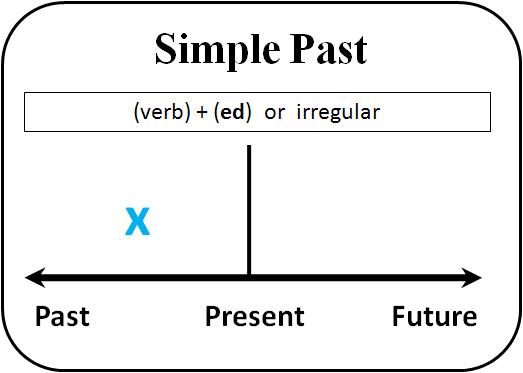


            Example :
a.       I watched this film last night.
b.      They were finished economic assignment yesterday.
c.       When did your last vacation ?
d.      Where did you wash your clothes ?

Keterangan waktu terkadang diperlukan dalam penggunaan past tense untuk memperjelas bahwa suatu peristiwa terjadi di masa lampau :
~ Just now                                           ~ Last Sunday
~ Yesterday                                         ~ This morning
~ The day before yesterday                ~ This afternoon
~ Last night                                        ~ Two days ago
~ Last week                                        ~ Several years ago

Example :
a.       (+) Mrs. Nia came to your party last week.
(-) Mrs. Nia didn’t come to your party last week.
(?) Did Mrs. Nia come  to your party last week ?
·         Yes, she did.
·         No, she didn’t.
b.      Who were the best student last year in this school ?
c.       We were run at this garden this morning.

-           Untuk menyatakan hasil yang dicapai, kita dapat menggunakan to be (was/were) + able to sebagai pengganti dari could.

            Example :
a.       Nita studied hard last night and finally she was able to pass her exams.
b.      He lost his phone and finally he was able to buy a new phone.

-           Untuk menyatakan kebiasaan yang dilakukan di masa lampau, kita dapat menggunakan used to atau would to + verb word.

            Example :
a.       When I was a kid, I used to play my car toys.
b.      Every time she played this game, she would be happy.

Source:
A Handbook of English Grammar: Panduan Lengkap dan Praktis Belajar Tata Bahasa Inggris: Imam Baehaqi


Source Picture:

https://www.google.co.id/search?q=Simple+Future+Tense+(Present+Future)&source=lnms&tbm=isch&sa=X&ved=0ahUKEwik5omB4NfTAhXFv48KHSZeC38Q_AUICigB&biw=1707&bih=766#tbm=isch&q=simple+past&imgrc=dpfhRZ_35p7vuM:

Present Perfect Continuos Tense


Present perfect continuous biasa digunakan untuk menyatakan kegiatan yang dimulai pada waktu lampau dan masih berlangsung sampai sekarang (sampai sekarang belum selesai).

                                    S + has/have + been verb-ing + [C]

Example :
a.       How long has been he been writing a paper ?
b.     have been waiting for this event since I watched this film.
c.      (+) Rey has been swimming for  1 hour.
(-) Rey has not been swimming for 1 hour.
(?)  Has Rey been swimming for 1 hour ?
·         Yes, he has.
·         No, he has not.


Source:

A Handbook of English Grammar: Panduan Lengkap dan Praktis Belajar Tata Bahasa Inggris: Imam Baehaqi


Source Picture:

https://www.google.co.id/search?q=Present+Perfect+Continuous+Tense&source=lnms&tbm=isch&sa=X&ved=0ahUKEwii5amX4tfTAhXJrI8KHXXjBRgQ_AUICygC&biw=1707&bih=766#imgrc=ZFxl1QZsigOM5M:

Present Continuous Tense

Present continuous digunakan dalam kegiatan yang sedang dilakukan atau sedang berlangsung dan kegiatan tersebut bersifat sementara serta cepat atau lambat akan berhenti meskipun dalam waktu yang sebentar maupun lama. 

S + am/is/are + verb-ing + [C]

Beberapa keterangan waktu atau clue yang digunakan antara lain :
~ Look                                                ~ Currently
~ Listen                                              ~ At this moment
~ Now                                                ~ Temporarily
~ Right now                                       ~ Today
~ For the time being                          ~ This week
~ This semester                                 ~ At the present time

Example:
a.       I am writing a letter for my best friend.
b.      They are sitting on the bench at café.
c.       What are you waiting for in here ?.
d.      She isn’t playing volley ball today.
e      (+) We are playing football in the field.
(-) We are not playing football in the field.
(?) Are we playing football in the filed ?
·         Yes, we are.
·         No, we are not.

Dalam memberikan penilaian kepada seseorang, maka kita dapat menggunakan pola => am/is/are + being + adjective.

Example :
a.       At this moment, she is being careful.

b.      I think  Tina is being careless recently.


Source:
A Handbook of English Grammar: Panduan Lengkap dan Praktis Belajar Tata Bahasa Inggris: Imam Baehaqi

Source Picture:
https://www.google.co.id/search?q=Present+Continuous+Tense&source=lnms&tbm=isch&sa=X&ved=0ahUKEwiU47rI4tfTAhUBOo8KHW5HAtAQ_AUICigB&biw=1707&bih=766#imgrc=tc-b_GlaIi1kRM:

Simple Present Tense

The Present Tense (The Simple Present) menunjukkan sense of permanence (fakta, kebenaran umum, keadaan atau kegiatan yang bersifat tetap atau tidak berubah).

S + Verb 1 ( + s/es) + [C]

-           Kebenaran Umum (General Truth)
Example :
a.       The earth is around.
b.      The sunrises from the east.
c.       The sunsets to west.
d.      The earth goes around the sun.

-          Kebiasaan (Habit)
Example :
a.       I usually wake up earlier in the morning.
b.      You seldom come late to first class.
c.       We always go to school by on foot.
d.      They sometimes go to college by car.

-           Perintah, Saran, atau Permintaan
Example :
a.       Open the door, please !
b.      Try to swim with your deep breath.
c.       Put your assignment in my desk job, please !
d.      Let’s come in !

-           Rencana / Jadual yang SudahPasti (Fixed Arrangements)
Example:
a.       Our final exams starts on 27th of June.
b.      My plane schedule takes off at 5 o’clock tomorrow tonight.
c.       They first college starts on 03rd of July.
d.      Our wedding party starts from 09.00 – 12.00 pm.

-           Rencana yang Akan Dilakukan
Example:
a.       I will give you a gift when you pass your exams.
b.      They come to your party when your birthday tomorrow night.
c.    (+) They study for exam tomorrow.
       (-) They don’t study for exam tomorrow.
       (?) Do they study for exam tomorrow ?
·         Yes, they do.
·         No, they don’t.

Frequency Adverbs with Present Tense
Adverbs yang sering digunakan dalam present tense adalah :
~ always                            ~ occasionally
~ never                              ~ seldom
~ sometimes                      ~ frequently
~ usually                            ~ rarely
~ generally                        ~ commonly
~ often

Example:
a.       I usually go to office by bus.
b.      We always support you.

Note: never, seldom, rarely, scarely, hardly, barely sudah mempunyai arti negatif, sehingga tidak dapat digunakan dalam kalimat negatif.

Example:
            She seldom smile => Benar.
She doesn’t seldom smile => Salah.


Source:

A Handbook of English Grammar: Panduan Lengkap dan Praktis Belajar Tata Bahasa Inggris: Imam Baehaqi

Source Picture:
https://www.google.co.id/search?q=simple+present&source=lnms&tbm=isch&sa=X&ved=0ahUKEwjs6tLo4tfTAhWDuI8KHQPNCxoQ_AUICigB&biw=1707&bih=766#tbm=isch&q=+present+tense&imgrc=iCpdooYnzq-cAM: